We’ve been working quietly behind the scenes, and we’re almost ready to share what we’ve been building.
Tuna Cans USA is launching soon.
Built With Purpose
From day one, our mission has been clear: to produce high-quality suppressors that are precision-machined in the USA and priced honestly — without the excessive markup that’s become normal in this industry.
Every design decision, machining pass, and refinement has been made with one goal in mind: deliver real performance at a price that makes sense.
Made in the USA — No Compromises
All Tuna Cans USA products are 100% manufactured and precision-machined in the United States.
We work with skilled American machinists who take pride in their craft, ensuring tight tolerances, consistent quality, and dependable performance across every product we release.
Designed for Real Use
Our suppressors aren’t built for marketing buzz — they’re built for real shooters.
We’ve focused on:
Practical sound suppression
Durable, reliable construction
Clean, functional designs that just work
No unnecessary complexity. No inflated pricing. Just solid equipment you can trust.
What’s Coming
At launch, we’ll be opening orders on our first lineup of suppressors and accessories, along with supporting gear designed to complement them.
We’ll also be sharing:
Product details and specifications
Ordering and transfer information
Answers to common questions for first-time suppressor buyers
Stay Tuned
We’re putting the final touches on everything and will be opening orders very soon.
If you’re looking for American-made suppressors built with intention and priced fairly, Tuna Cans USA is almost ready.
Tuna Cans USA
Precision-machined suppressors. Made in America. Launching soon.
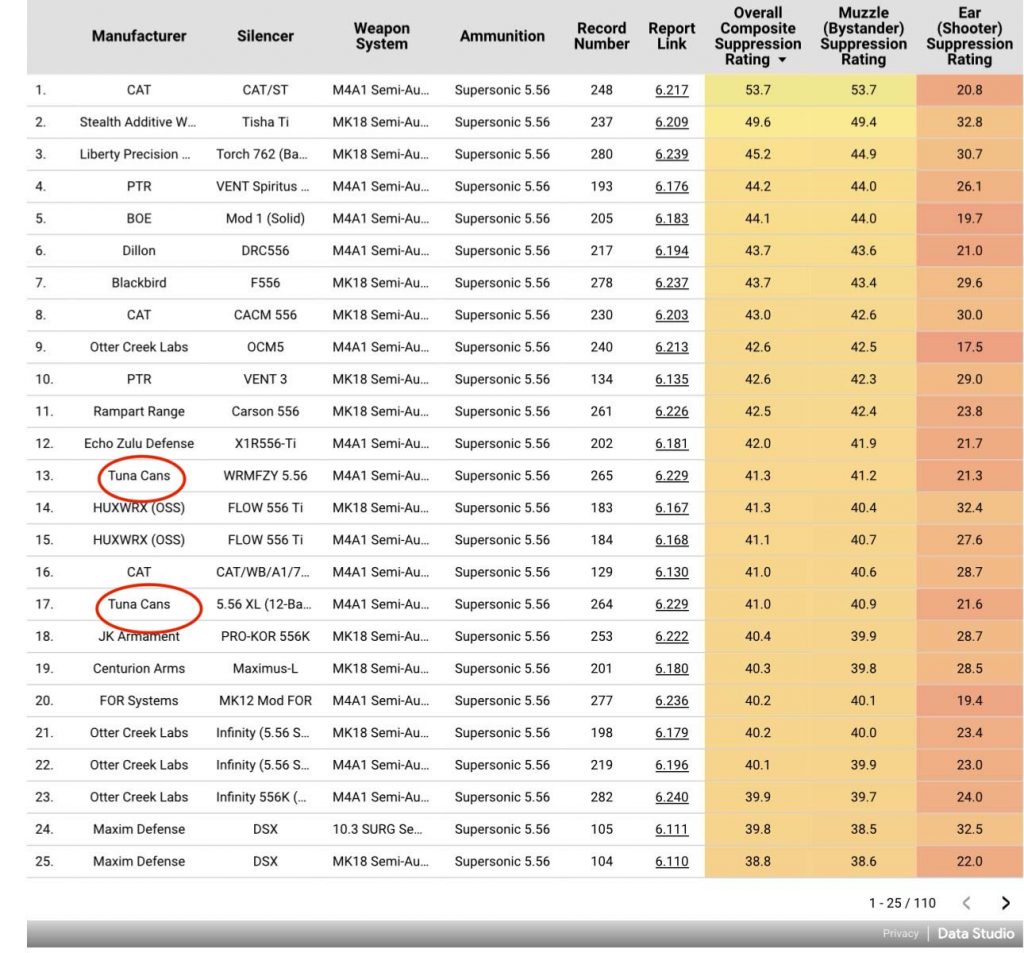
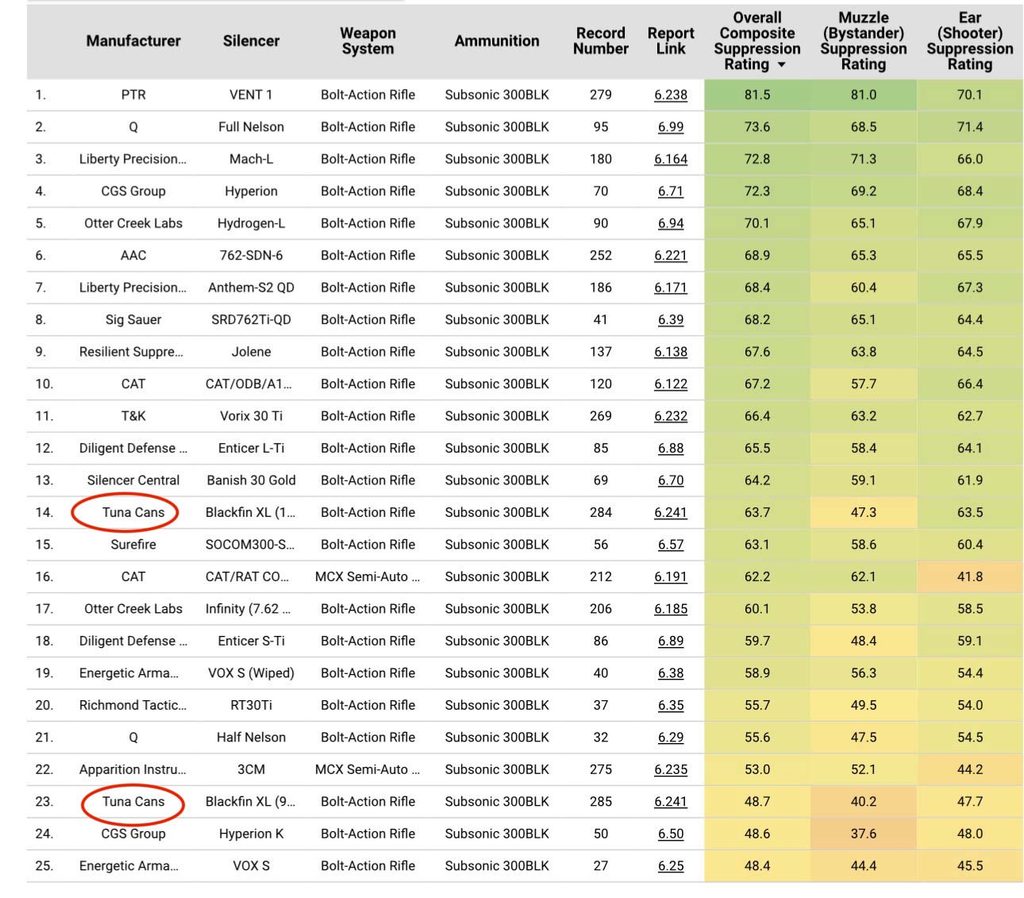
When it comes to suppressor performance, the numbers speak for themselves. We’re highlighting four Tuna Cans silencers featured in performance rankings based on data from PEW Science, an independent source for suppressor sound signature analysis.
5.56 Performance: 5.56XL & WRMFZY
Our 5.56XL 12-Baffle and 5.56 WRMFZY 3D-Printed silencers are featured in the rankings above, showcasing how they compare against other suppressors across key performance metrics.
Want to dig deeper into the numbers? Check out the full analysis on PEW Science for a detailed breakdown of the testing, methodology, and results.
Our Blackfin XL and Blackfin L also make an appearance in the performance rankings. The chart above provides a look at how both models stack up against other silencers in their category.
For a closer look at the data and what these rankings mean, visit PEW Science to explore the complete analysis.
At Tuna Cans, we believe in letting the data speak for itself. Explore the rankings, review the independent analysis, and see how our silencers compare.
A major federal court ruling that took effect on August 13, 2026 has changed how certain suppressor purchases may be handled.
The court ruled that several National Firearms Act registration and approval requirements can no longer be enforced against the plaintiffs and certain covered members and customers for firearms whose federal transfer and making taxes were reduced to $0. The injunction includes key provisions associated with the Form 4 approval process and federal NFA registration.
For eligible suppressor transactions in states that do not independently require NFA registration, this may allow for a significantly simpler transfer process.
However, this is still a developing area of law, and buyers should not assume that every FFL or SOT will immediately interpret or implement the ruling in the same way. Dealers may have different legal guidance, compliance policies, or risk tolerances, and some may continue requiring the traditional NFA process while the scope and practical effect of the ruling are further clarified.
How Tuna Cans Is Handling Transfers
On our end, Tuna Cans is continuing to use the ATF Form 3 process for dealer-to-dealer transfers. We are maintaining our existing internal transfer procedures to remain compliant while the legal landscape continues to develop.
Once the suppressor reaches the receiving dealer, that dealer is responsible for determining how the final transfer to the customer will be handled based on applicable federal law, state law, the court order, and the dealer’s own legal and compliance guidance.
Because of this, we strongly recommend confirming the transfer process with your receiving FFL/SOT before placing an order. Do not assume that a particular dealer will complete a transfer without a Form 4 simply because the transaction may qualify under the ruling.
Legal Disclaimer: This information is provided for general informational purposes only and is not legal advice. The August 2026 ruling involves an evolving area of federal firearms law, and its application may vary depending on the buyer, product, dealer, state, and specific circumstances. If you have questions about whether the ruling applies to you or how a transfer should be handled, consult a qualified attorney familiar with federal and state firearms law.
Which Products Are Covered?
The ruling applies to certain suppressors and AOWs (Any Other Weapons) purchased through Tuna Cans, provided the product qualifies under the court order.
Covered Products
Suppressors (silencers) purchased from Tuna Cans
AOWs (Any Other Weapons) purchased from Tuna Cans
Products Not Covered
The ruling does not remove existing NFA requirements for the following:
SBRs (Short-Barreled Rifles) — Form 4 requirements still apply due to separate requirements under the Gun Control Act (GCA).
SBSs (Short-Barreled Shotguns) — Form 4 requirements still apply for the same reason.
Machine Guns — Not covered by the ruling.
Destructive Devices — Not covered by the ruling.
How the Ruling Applies by State
Your purchase process depends on the laws in your state. States generally fall into three categories: Free States, NFA States, and Prohibited States.
Free States — 27 States
In these states, qualifying suppressors and AOWs are treated as GCA items, meaning a Form 4 is not required under the ruling.
Alabama
Arizona
Arkansas
Florida
Idaho
Indiana
Iowa
Kansas
Kentucky
Louisiana
Maine
Maryland
Minnesota
Missouri
Nebraska
New Hampshire
New Mexico
Oklahoma
South Carolina
South Dakota
Tennessee
Texas
Utah
Vermont
Virginia
West Virginia
Wyoming
States Where NFA Requirements Still Apply — 15 States
In these states, state law still requires the traditional Form 4 process for suppressors and AOWs despite the federal court ruling.
Alaska
Colorado
Connecticut
Georgia
Michigan
Mississippi
Montana
Nevada
North Carolina
North Dakota
Ohio
Oregon
Pennsylvania
Washington
Wisconsin
States Where Suppressors Remain Prohibited
The ruling does not override state or local bans. Suppressors remain prohibited in the following jurisdictions:
California
Delaware
Hawaii
Illinois
Massachusetts
New Jersey
New York
Rhode Island
Washington, D.C.
What to Expect in a Free State
If you live in a Free State and are purchasing a qualifying suppressor or AOW through Tuna Cans that falls within the court ruling, the transfer process is significantly simpler than the traditional NFA process.
The Purchase Process
Purchase your suppressor or AOW from Tuna Cans.
Your order is shipped to your selected licensed dealer.
Once it arrives, visit the dealer and complete a standard ATF Form 4473.
Complete the required NICS background check.
Once approved, take your suppressor home.
There is no Form 4 filing, fingerprint submission, NFA registration, or ATF approval period for qualifying suppressors and AOWs covered by the ruling in these states.
In short: no Form 4 and no traditional NFA wait.
The federal transfer tax is currently $0, so there is no $200 tax payment associated with the transfer.
What to Expect in States That Still Require NFA Processing
In states where state law continues to require NFA registration, suppressors and AOWs must still go through the traditional Form 4 process before they can be transferred to the buyer.
That process generally includes:
Providing your fingerprints and photograph
Completing the required personal information
Having an ATF eForms account
Reviewing and certifying your Form 4
Electronically signing the required documents
Waiting for ATF approval before taking possession
The transfer tax remains $0, but the registration and approval process still applies in these states.
SBRs and SBSs Follow a Separate Process
The ruling does not eliminate the Form 4 process for Short-Barreled Rifles (SBRs) or Short-Barreled Shotguns (SBSs).
These firearms are subject to separate requirements under the Gun Control Act (GCA), so a Form 4 is still required in states where they are legal.
The federal transfer tax is currently $0, but buyers must still complete the required paperwork and receive approval before taking possession.
Common Questions About the New Process
Do I still have to register my suppressor?
If you are in a Free State and your suppressor or AOW qualifies under the ruling, the traditional federal NFA registration process does not apply to the transfer.
In states that continue to require NFA processing under state law, a Form 4 is still required.
Do I still need to file a Form 4?
It depends on the product and the state where you live.
Free States: A Form 4 is not required for qualifying suppressors and AOWs covered by the ruling.
States That Still Require NFA Processing: A Form 4 is still required for suppressors and AOWs.
SBRs and SBSs: A Form 4 is still required regardless of the ruling.
What happened to the tax stamp?
The federal transfer tax was reduced to $0 effective January 1, 2026.
The court ruling described here goes beyond the tax itself by changing whether the underlying NFA registration process can be enforced for certain qualifying suppressor and AOW transfers in covered states.
So while the tax was already $0, the important change for qualifying buyers in Free States is the removal of the traditional Form 4 registration and approval process.
How long does a purchase take in a Free State?
There is no longer a separate ATF Form 4 approval period for qualifying transfers.
Once your suppressor arrives at your selected dealer, you can complete the Form 4473 and NICS background check required for the transfer. If the transfer is approved and there are no other delays, you can take possession without waiting for a Form 4 approval.
Do I need to be a Gun Owners of America member to qualify?
Yes. To qualify for protection under the ruling, you must be a current member of Gun Owners of America (GOA).
Your membership should be active at the time of purchase and transfer. In addition, the suppressor or AOW must otherwise meet the requirements of the ruling and be transferred in a state where the ruling applies.
If you are not already a GOA member, you will need to join Gun Owners of America before completing your qualifying purchase or transfer.
Could these rules change?
Yes. This ruling is part of an ongoing legal matter, and future court decisions, appeals, legislation, or regulatory action could change how these transfers are handled.
The information on this page reflects the current process described by the ruling. Buyers with questions about their individual legal situation should consult a qualified attorney.
Are machine guns and destructive devices included?
No.
Machine guns and destructive devices are not covered by this ruling and remain subject to their existing federal requirements.
The separate $200 transfer tax also continues to apply to these categories where applicable.
What if I purchased my suppressor before August 13, 2026?
If you currently have a pending Form 4 for a qualifying suppressor or AOW, the ruling may affect how your transfer can be completed.
Contact Tuna Cans or your transferring dealer for guidance regarding your specific order before making any changes to an existing application.
If your Form 4 has already been approved and the suppressor has already been transferred to you, there is generally no additional purchase-related action to take.
Can I still use a Form 4 in a Free State?
A customer may choose to continue with the traditional Form 4 process even when the ruling allows a qualifying transfer to proceed without one.
If you prefer that option, speak with your transferring dealer before completing the transfer so they can explain the process available for your order.
The arrival of Lyman’s Sonicore suppressor line gives buyers another option in the growing market for affordable, modular suppressors. At first glance, Sonicore and Tuna Cans have several things in common: both offer modular designs, both emphasize value, and both cover many of the most common rifle, pistol, and rimfire calibers.
Under the surface, however, the two product lines take noticeably different approaches to materials, construction, mounting systems, weight, and intended firing schedules.
This comparison looks at Tuna Cans vs. Lyman Sonicore from a technical standpoint, including the differences between their .22, 5.56/.223, .30-caliber, and 9mm suppressors.
Tuna Cans vs. Sonicore Silencers: Quick Comparison
At first glance, Tuna Cans and Lyman Sonicore suppressors compete in a similar price range and share some of the same basic ideas, including modular construction and multiple caliber options. The biggest difference is what you’re actually getting for that money.
Tuna Cans puts substantially more emphasis on materials, durability, and manufacturing capability at its price point. Our lightweight suppressors use high-strength 7075 aluminum, while our heavy-duty centerfire models are constructed from heat-treated 17-4 precipitation-hardening stainless steel. Sonicore uses 6026-T9 aluminum and 303 stainless steel, depending on the model.
Those are not simply different grades of otherwise interchangeable materials. Published mechanical-property data shows 7075-T6 with substantially greater tensile and yield strength than 6026-T9, while properly heat-treated 17-4 PH stainless can achieve dramatically greater strength than 303 stainless. Finished suppressor performance depends on more than material specifications alone, but the difference helps explain why Tuna Cans can offer products rated for substantially more demanding firing schedules.
Tuna Cans suppressors are also manufactured in-house in the United States. Rather than choosing lower-cost materials to hit an affordable price point, our goal has been to manufacture suppressors from premium materials while keeping the final price accessible.
That creates what we believe is one of the strongest value propositions in the category: premium construction and heavy-duty capability without moving into premium suppressor pricing.
Tuna Cans
Lyman Sonicore
Price Positioning
Affordable modular suppressors built with premium materials
All-7075, hybrid 7075/17-4, and all-17-4 stainless platforms
6026-T9 aluminum and 303 stainless depending on model
Full-Auto Rated
Yes, on applicable models and calibers
No
Belt-Fed Rated
Yes, on applicable models and calibers
No
Manufacturing
Manufactured in-house in the USA
—
Mounting
HUB-compatible on many centerfire models
Direct-thread and over-barrel configurations depending on model
Product Range
.22, 5.56/6mm, .30 Cal, 9mm, .40/10mm and .46 Cal families
.22, .223, .30 Cal and 9mm families
More Material for Your Money
This is where the Tuna Cans vs. Sonicore comparison becomes particularly important for value-conscious buyers.
Affordable suppressors often require compromises somewhere in the design. One way to reduce manufacturing cost and weight is through material selection. Tuna Cans takes a different approach: we use the same types of high-strength materials commonly associated with much more expensive suppressors while keeping our products within the affordable end of the market.
Our aluminum suppressors use 7075 rather than a lower-strength aluminum alloy, and our heavy-duty stainless models use heat-treated 17-4 PH rather than a general-purpose machinable stainless such as 303. We also manufacture our suppressors in-house in the United States, giving us direct control over machining, assembly, and production.
The result is that buyers don’t have to choose between an affordable suppressor and premium construction.
For shooters primarily concerned with minimizing weight, Sonicore’s aluminum-focused construction may have advantages. But for buyers comparing Tuna Cans vs. Lyman Sonicore based on what they receive for their money, Tuna Cans offers higher-strength material options, full-auto and belt-fed capability on applicable models, a broader range of constructions and calibers, and U.S. in-house manufacturing at a similar overall price point.
Tuna Cans vs. Sonicore: The Biggest Difference Is Construction
Perhaps the most significant difference between the two suppressor lines is the choice of materials.
Lyman states that Sonicore suppressors use 6026-T9 aluminum and 303 stainless steel, depending on the model. Its Rekkr and Paradox centerfire rifle suppressors use aluminum baffle modules combined with 303 stainless-steel inserts to form what Lyman describes as a stainless-steel “core.” The Skarv 22 is constructed from 6026-T9 aluminum, while the Valor 9 uses 6026-T9 aluminum and 303 stainless steel.
Tuna Cans uses several different construction strategies across its lineup.
Its dedicated 5.56, 30 Cal, 9mm, .40/10mm and .46-caliber stainless suppressors are machined from heat-treated 17-4 stainless steel. Other models, including the .22, FAT9 and SLIM9 families, use 7075 aluminum. The BlackFin takes a hybrid approach, combining a heat-treated 17-4 stainless blast chamber and first baffle with 7075 aluminum for the remaining baffles and end cap.
That means this isn’t simply an “aluminum suppressor versus stainless suppressor” comparison. Tuna Cans offers both lightweight aluminum designs and considerably heavier all-stainless designs depending on the intended application.
7075 Aluminum vs. 6026-T9 Aluminum
Both companies use aluminum where keeping weight down is important, but they use different alloys.
Sonicore specifies 6026-T9 aluminum, while Tuna Cans’ aluminum models use 7075 aluminum.
Published mechanical-property data provides some useful context:
Material
Published Tensile Strength
Published Yield/Proof Strength
6026-T9 aluminum
~360 MPa
~330 MPa
7075-T6 aluminum
~540 MPa
~485 MPa
On those published bar-property values, 7075-T6 has approximately 50% greater ultimate tensile strength and about 47% greater yield strength than 6026-T9. Actual finished-component performance depends on temper, geometry, machining and other manufacturing factors, so alloy numbers alone should not be interpreted as a direct prediction of suppressor lifespan.
The difference does, however, illustrate the design philosophy behind Tuna Cans’ aluminum models: use a higher-strength aluminum alloy while preserving the weight advantages associated with aluminum construction.
17-4 Stainless Steel vs. 303 Stainless Steel
The difference becomes even greater when looking at the stainless alloys used by the two companies.
Lyman specifies 303 stainless steel for the stainless components in its Rekkr and Paradox suppressors and identifies 303 stainless alongside 6026-T9 in the Valor 9.
Tuna Cans’ stainless models use heat-treated 17-4 precipitation-hardening stainless steel.
303 is an austenitic stainless alloy particularly well known for machinability. Published ATI data for 303 lists tensile strength in the approximately 517–621 MPa range.
17-4 PH, by comparison, is specifically capable of being precipitation hardened. Its mechanical properties vary substantially with heat-treatment condition. As a reference point, published H900 data lists tensile strength around 1,310 MPa and yield strength around 1,170 MPa.
For that reason, simply calling both materials “stainless steel” misses a considerable metallurgical difference between them.
Full-Auto and Belt-Fed Rating: A Major Difference in Intended Use
Another important difference between Tuna Cans and Lyman Sonicore is the firing schedule each product line is designed and rated to handle.
Tuna Cans offers suppressors rated for full-automatic and belt-fed use, depending on the model and applicable caliber/barrel-length requirements. This capability is closely tied to the heavier-duty construction used throughout the Tuna Cans lineup, particularly the models built from heat-treated 17-4 stainless steel.
Lyman takes a different approach with Sonicore. Lyman specifically states that Sonicore suppressors are not full-auto rated due to the materials used in their construction. Lyman also publishes rate-of-fire recommendations for certain Sonicore models and warns that exceeding those recommended firing schedules can result in premature suppressor failure.
This represents more than a difference in material specifications on paper. It reflects two different design priorities. Sonicore places greater emphasis on keeping suppressor weight down through its use of aluminum and 303 stainless-steel components, while Tuna Cans offers heavier-duty constructions intended to tolerate substantially more demanding firing schedules.
For buyers comparing Tuna Cans vs. Sonicore, particularly for 5.56 and other centerfire applications, the manufacturer’s firing rating is therefore an important specification to consider alongside weight, dimensions, mounting system and material choice.
Tuna Cans 5.56 vs. Lyman Sonicore .223
For someone comparing a Tuna Cans 5.56 vs. Sonicore 5.56/.223 suppressor, the difference in construction philosophy is particularly obvious.
Sonicore offers .223 versions of both the Rekkr and Paradox, with direct-thread and over-barrel configurations. Both use 6026-T9 aluminum baffle modules with 303 stainless-steel inserts. The Rekkr uses thicker walls and is positioned by Lyman for higher-volume semi-automatic use, while the Paradox prioritizes reduced weight.
The direct-thread Rekkr is 7.60 inches long, 1.77 inches in diameter and 14.6 ounces at full length. The Paradox DT maintains the same 7.60-inch length and 1.77-inch diameter but drops weight to 13 ounces. Lyman lists neither model as full-auto rated.
The Tuna Cans 5.56 family takes a different approach. The S, L and XL models use heat-treated 17-4 stainless steel rather than an aluminum/stainless hybrid construction. The 5.56 S, for example, is 6.25 inches long, 1.50 inches in diameter and weighs 16 ounces. The 5.56 L increases to 7.76 inches and 20 ounces. Both are listed by Tuna Cans as full-auto rated for .223/5.56 subject to the published barrel-length restrictions.
In practical design terms, Sonicore emphasizes lower weight, while the Tuna Cans 5.56 series accepts additional weight in exchange for an all-17-4 stainless construction and a different manufacturer-rated firing envelope.
There is also an important mounting difference. Sonicore’s Rekkr and Paradox are direct-thread systems, with over-barrel versions also available. Tuna Cans’ current stainless 5.56 models use the common 1.375×24 HUB interface, allowing the suppressor body to accept different compatible mounting systems rather than permanently committing the user to one direct-thread configuration.
Tuna Cans .30 Cal vs. Sonicore .30 Cal
The Tuna Cans .30 Cal vs. Sonicore .30 Cal comparison follows a similar pattern.
Lyman offers .30-caliber versions of its Rekkr and Paradox in both direct-thread and over-barrel configurations. Like the .223 versions, these use 6026-T9 aluminum modules and 303 stainless-steel baffle inserts.
Tuna Cans offers two distinct approaches in this category.
The regular 30 Cal S, L and XL suppressors use heat-treated 17-4 stainless steel throughout. The 30 Cal S, for example, is 6.24 inches long, weighs 16 ounces and uses a HUB-compatible mounting interface.
The BlackFin S, L and XL provide an alternative for shooters prioritizing reduced weight. The BlackFin combines a heat-treated 17-4 blast chamber and first blast baffle with 7075 aluminum for the remaining baffles and end cap. The BlackFin L weighs 12.5 ounces despite measuring 8.5 inches long.
This gives Tuna Cans two materially different answers to the .30-caliber problem: an all-stainless platform focused on strength and a hybrid 17-4/7075 platform focused more heavily on weight reduction.
Tuna Cans 9mm vs. Lyman Sonicore Valor 9
The 9mm category has an even wider range of construction choices.
Lyman’s Sonicore Valor 9 is a modular 9mm pistol suppressor measuring 7.32 inches long, 1.36 inches in diameter and 7.8 ounces at full length. It uses eight removable baffles, incorporates 6026-T9 aluminum and 303 stainless steel, and includes a booster and piston. Lyman does not list it as full-auto rated.
Tuna Cans currently offers three different 9mm platforms:
SLIM9 S and XL — compact 7075-aluminum designs.
FAT9 S, L and XL — larger-volume 7075-aluminum designs.
9mm S, L and XL — heat-treated 17-4 stainless-steel designs.
The result is a substantially different product strategy. Rather than one construction optimized around a particular balance of weight and durability, Tuna Cans separates those priorities into multiple 9mm families.
For example, the SLIM9 S weighs only 2.5 ounces and measures 3 inches long, using 7075 aluminum throughout. At the other end of the spectrum, the stainless Tuna Cans 9mm S weighs 16 ounces and uses heat-treated 17-4 stainless steel.
The FAT9 sits between those approaches, using 7075 aluminum with a larger 1.625-inch diameter and HUB mounting interface.
So a comparison of Tuna Cans 9mm vs. Sonicore Valor 9 depends heavily on which Tuna Cans family is being considered.
Tuna Cans .22 vs. Sonicore Skarv 22
The rimfire comparison is much more direct because both products use all-aluminum modular construction.
The Sonicore Skarv 22 uses 6026-T9 aluminum, measures 5 inches long and 1.13 inches in diameter, and weighs 3.2 ounces. It uses a 1/2×28 direct-thread mount and is not listed by Lyman as full-auto rated.
The Tuna Cans .22 S uses 7075 aluminum, measures 3 inches long and approximately 1.125 inches in diameter, and weighs 2.5 ounces. Tuna Cans lists it as full-auto rated for .22 LR under its published usage guidance.
Tuna Cans also offers .22 XL and .22 XXL versions with 10- and 15-baffle configurations respectively, whereas the Sonicore lineup currently centers around the Skarv 22 platform.
For buyers specifically researching Tuna Cans .22 vs. Sonicore Skarv 22, the alloy selection and available size configurations are therefore two of the clearest differences.
Calibers Where Sonicore Currently Has No Direct Equivalent
The current Tuna Cans modular lineup contains 26 models/configurations spread across .22, 5.56/6mm, .30 caliber, 9mm, .40/10mm and .46-caliber categories.
Lyman introduced Sonicore as four principal families: Skarv 22, Rekkr, Paradox and Valor 9, with Rekkr and Paradox available in .223 and .30-caliber configurations.
As a result, Tuna Cans currently has dedicated .40/10mm and .46-caliber suppressor families for which the announced Sonicore lineup does not have a direct same-caliber counterpart.
Both Designs Are Modular, but They Approach Modularity Differently
One thing Tuna Cans and Sonicore genuinely have in common is modular construction.
Lyman designed Sonicore models so modules can be removed to reduce overall suppressor length, and the company emphasizes user servicing and disassembly as core features of the line.
Tuna Cans likewise uses serviceable threaded baffle stacks across much of its lineup, with different S, L and XL configurations allowing buyers to choose different baffle counts and overall sizes from the outset.
The difference is therefore less about whether the suppressors are modular and more about the materials, mounting systems and firing envelopes surrounding that modular architecture.
So, How Do Tuna Cans and Sonicore Actually Differ?
The biggest difference between Tuna Cans and Lyman Sonicore is not simply weight, modularity, or mounting style. It is what each company is delivering at a similar price point.
Sonicore’s approach emphasizes lightweight construction, modularity, and direct-thread simplicity. Its centerfire rifle suppressors use 6026-T9 aluminum modules with 303 stainless-steel inserts, helping keep weight relatively low. Lyman also offers different Sonicore configurations aimed at hunting and higher-volume semi-automatic use, but states that the Sonicore line is not full-auto rated.
Tuna Cans takes a different approach to value. Rather than relying on one construction strategy, we use materials based on the intended application. Our lightweight models use high-strength 7075 aluminum, hybrid models combine 7075 with heat-treated 17-4 stainless steel, and our heavy-duty centerfire suppressors use heat-treated 17-4 stainless throughout. Many of our centerfire models also use the standardized 1.375×24 HUB mounting interface and are rated for full-auto—and, where applicable, belt-fed—use.
Just as importantly, Tuna Cans suppressors are manufactured in-house in the United States. By controlling production ourselves, we are able to put higher-cost materials and heavier-duty construction into suppressors while keeping them in the same general affordable price category as competing modular designs.
That is ultimately where we believe the value difference becomes clear.
A buyer comparing Tuna Cans vs. Lyman Sonicore is not simply choosing between two similarly priced modular suppressors. In many cases, the Tuna Cans option provides higher-strength materials, more demanding firing ratings, HUB compatibility, U.S. in-house manufacturing, and a broader range of construction choices without requiring the buyer to move into a substantially higher price tier.
There are still tradeoffs. An all-17-4 stainless suppressor will generally weigh more than an aluminum-focused design, and shooters whose highest priority is minimizing weight may prefer that compromise. But for buyers prioritizing durability, material quality, firing capability, mounting flexibility, and overall value for the money, Tuna Cans is designed to deliver considerably more hardware at a comparable price point.
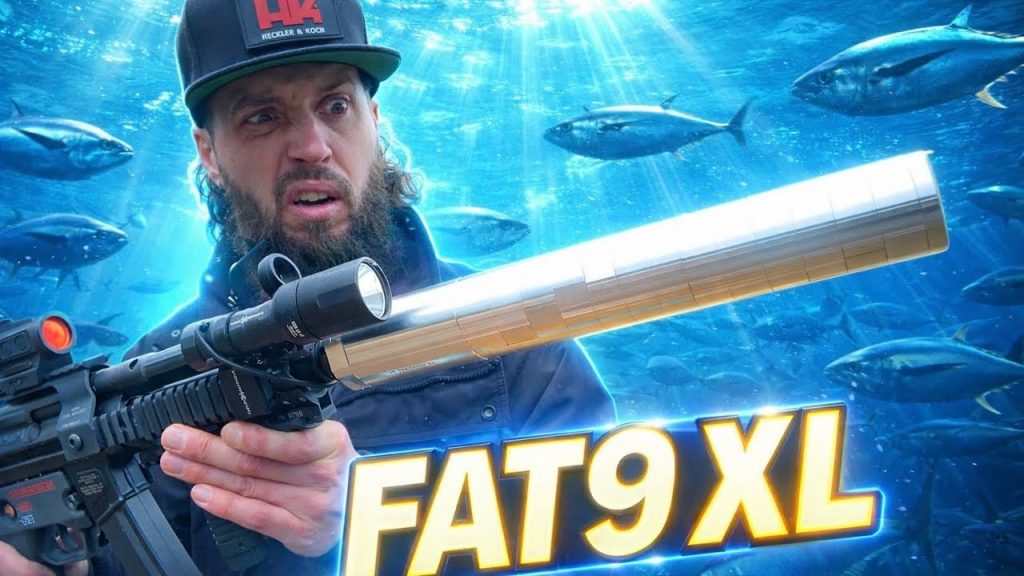
The suppressor industry has been dominated for decades by premium brands charging $800–$1,500 for what most shooters really want: quieter guns, less concussion, and better range experiences. But that model is changing fast — and a recent influencer review of the Tuna Cans Fat 9 XL shows exactly why.
In a hands-on YouTube comparison, the Fat 9 XL went head-to-head with two well-known competitors:
Hux Works 9K TI (Titanium)
SilencerCo Omega 36M (Stainless Steel)
Despite costing hundreds of dollars less, the Tuna Can not only held its own — in several tests, it outperformed the more expensive cans.
Here’s what the reviewer found.
Why Tuna Cans Is Disrupting the Suppressor Market
The reviewer opens by explaining why Tuna Cans is getting so much attention in the first place.
For years, suppressor pricing was inflated by:
NFA tax burdens
Import costs
Boutique manufacturing
Premium materials used more for marketing than function
With the removal of the federal tax and modern CNC manufacturing, Tuna Cans took a different approach: strip away unnecessary cost while preserving real-world performance.
That’s how Tuna Cans can offer:
9mm suppressors under $300
5.56 suppressors under $300
Fully modular designs
Meanwhile, most competing brands still charge $500 to $1,500+ for comparable performance.
Meet the Fat 9 XL
The Fat 9 XL is Tuna Cans’ flagship 9mm suppressor. It isn’t trying to look fancy — it’s designed to perform.
Key Design Features
Modular baffle system
12 baffles standard
Review unit had 13 baffles
Can be run:
Full length (“long boy”)
Mid-length
Short configuration
This gives shooters control over:
Overall length
Weight
Sound suppression
You don’t get that flexibility with most traditional suppressors.
Raw Aluminum Finish: Why Tuna Cans Chose It
One thing that stands out immediately is the raw aluminum finish.
The reviewer explains that this was a deliberate decision:
It keeps costs low
It avoids unnecessary coatings
It lets users customize the look with high-temp paint
Instead of paying $200 more for Cerakote, you can:
Rattle-can it
Match it to your firearm
Repaint it anytime
Functionally, nothing is sacrificed — it’s purely aesthetic.
Live Fire Sound Test Results
The real test was how the Fat 9 XL performed against premium suppressors.
The reviewer tested three ammo types:
115 grain
124 grain
147 grain
And compared:
Tuna Cans Fat 9 XL
Hux Works 9K TI
SilencerCo Omega 36M
What He Heard
Across nearly every configuration:
The Fat 9 XL was quieter than the Hux Works 9K TI.
That’s impressive, because the Hux is:
Titanium
Lighter
More than double the price
The Omega 36M sometimes had a slightly deeper tone on heavy grain ammo, but the difference was small and subjective.
In several setups, the Tuna Can sounded just as quiet or quieter, especially in real-world shooter perception.
Material Differences & Sound Tone
The reviewer also broke down how materials affect sound.
Material
Sound Character
Stainless Steel (Omega 36M)
Deeper, lower-frequency tone
Titanium (Hux 9K)
Slightly sharper
Aluminum (Fat 9 XL)
Clean, efficient suppression with a slightly higher pitch
What matters most isn’t the pitch — it’s total sound reduction, and that’s where Tuna Cans delivered.
Weight Comparison
Suppressor
Weight
Hux 9K TI
Lightest
Fat 9 XL
Moderate
Omega 36M
Heaviest
Titanium is lighter — but the reviewer points out something important:
Weight doesn’t matter if the suppressor isn’t as quiet.
The Fat 9 XL strikes a strong balance between:
Weight
Suppression
Modularity
Price
Price vs Performance: The Real Story
This is where Tuna Cans truly shines.
Suppressor
Price
Performance
Fat 9 XL
Under $300
Quieter than Hux, competitive with Omega
Hux 9K TI
$$$
Louder in most tests
Omega 36M
$$$$
Slight tone advantage, much heavier
The reviewer’s takeaway was clear:
“You’re not paying for performance — you’re paying for brand.”
Tuna Cans is proving that modern suppressor design doesn’t need luxury pricing.
Why Shooters Are Switching to Tuna Cans
The Fat 9 XL hits a sweet spot:
Modular
Quiet
Affordable
Upgradeable
Customizable
For first-time buyers, it removes the biggest barrier: price. For experienced shooters, it offers flexibility that most “premium” cans don’t.
Final Verdict
The YouTube reviewer summed it up best:
Tuna Cans may not have flashy finishes or marketing hype — but when it comes to what actually matters on the firing line, the Fat 9 XL competes with suppressors that cost two to four times more.
For shooters who care about:
Performance
Value
Modularity
Real-world results
…the Fat 9 XL is one of the smartest suppressor buys on the market today.
Searching for the best handgun silencer can be overwhelming, especially for first-time buyers. With dozens of models, calibers, mounting systems, and legal requirements to consider, it’s important to understand what actually makes a handgun suppressor a good choice for your specific use case. Rather than focusing on hype or brand claims, the best handgun suppressor is the one that balances performance, reliability, legality, and value.
This guide breaks down everything you need to know before buying a handgun suppressor, including how suppressors work, what features matter most, and how to legally purchase one online through a licensed dealer.
What Is a Handgun Suppressor?
A handgun suppressor—often called a pistol suppressor—is a device designed to reduce the sound, muzzle blast, and recoil of a handgun when fired. Most handgun suppressors use a series of internal baffles to slow and cool expanding gases, resulting in a quieter and more controlled shooting experience.
Handgun suppressors are commonly used for:
Hearing protection at the range
Reduced recoil and muzzle rise
More comfortable shooting, especially with subsonic ammunition
Contrary to popular myths, suppressors do not make firearms silent. They simply reduce noise to safer levels.
What Makes the “Best Handgun Silencer”?
The best handgun silencer is not a one-size-fits-all product. Instead, it depends on several key factors that every buyer should evaluate.
1. Caliber Compatibility
Most handgun suppressors are caliber-specific. Popular options include:
9mm handgun suppressors
.45 ACP handgun suppressors
Multi-caliber suppressors rated for multiple pistol calibers
Choosing the correct caliber rating is critical for safety and performance.
2. Sound Suppression Performance
Sound reduction is measured in decibels, but real-world performance depends on:
Ammunition choice (subsonic vs supersonic)
Barrel length
Baffle design
The best handgun suppressors focus on balanced suppression rather than chasing unrealistic “silent” claims.
3. Weight and Balance
Because handgun suppressors attach to the muzzle, weight matters. A suppressor that is too heavy can affect:
Sight alignment
Cycling reliability
Overall shooting comfort
Many shooters prioritize lightweight designs that maintain balance while still providing effective suppression.
4. Mounting System (Booster / Piston)
Most handgun suppressors use a Nielsen device (booster) to ensure proper cycling on semi-automatic pistols. A quality mounting system:
Improves reliability
Reduces malfunctions
Allows compatibility with threaded handgun barrels
This is a non-negotiable feature for most pistol suppressors.
5. Durability and Materials
Common materials include:
Stainless steel
Aluminum
Titanium
The best handgun suppressors are built to withstand repeated firing and standard handgun calibers without excessive wear.
6. Price and Overall Value
Price alone does not determine quality. Many shooters are surprised to learn that affordable handgun suppressors can perform extremely well when unnecessary markup is removed.
Companies like Tuna Cans USA focus on value-driven suppressor designs that meet real-world needs without inflated pricing.
Are Handgun Suppressors Legal?
Yes, handgun suppressors are legal under federal law and regulated by the National Firearms Act (NFA). They are legal to own in most U.S. states, though some states restrict or prohibit civilian ownership.
Before purchasing, buyers should always confirm suppressor legality in their state.
How to Buy a Handgun Suppressor Online
Buying a handgun suppressor online is legal and common, but the process differs from purchasing standard firearm accessories.
The Process:
Purchase the suppressor online from a reputable seller
Select a licensed FFL dealer who handles NFA transfers
The suppressor is shipped to the FFL, not to your home
You complete ATF Form 4, fingerprints, and photographs
Pay the $200 federal tax stamp
Undergo a background check
After approval, pick up your suppressor from the FFL
At Tuna Cans USA, all suppressors are shipped exclusively to licensed FFL dealers to ensure full legal compliance.
Common Myths About the Best Handgun Suppressors
“The most expensive suppressor is the best.” Not true. Performance depends on design, not just price.
“Suppressors are illegal or heavily restricted.” They are legal in most states when purchased properly.
“Buying online is risky or complicated.” With a clear process and a reputable dealer, buying online is straightforward and secure.
Choosing the Right Handgun Suppressor for You
Rather than searching for a single “best handgun silencer,” buyers should focus on:
Intended caliber
Realistic performance expectations
Reliability
Legal compliance
Overall value
For many shooters, the best suppressor is one that delivers dependable performance at an affordable price, backed by clear guidance and transparent purchasing steps.
Final Thoughts
The best handgun suppressor is the one that fits your firearm, your budget, and your intended use—while complying fully with federal and state laws. By understanding how suppressors work, what features matter, and how the purchasing process works, buyers can make informed decisions with confidence.
Tuna Cans USA is committed to making suppressor ownership more accessible by offering affordable handgun suppressors, transparent pricing, and a legally compliant buying process through licensed FFL dealers.
How to buy a silencer online legally is a topic that generates a lot of questions, especially for first-time buyers. Many people wonder whether it’s legal, how the process works, and what steps are required before they can take possession of a suppressor. The short answer is yes—buying suppressors online is legal in most U.S. states, but the process is regulated under federal law and differs from buying standard firearm accessories.
At Tuna Cans USA, we specialize in affordable suppressors and make the online purchasing process as transparent and straightforward as possible. Understanding how suppressor laws work can help you confidently and legally complete your purchase. This guide will give you everything you need to learn how to buy a silencer online legally, including FFL transfer, tax stamp, and background check requirements
Are Suppressors Legal in the United States?
Suppressors, often referred to as silencers, are legal under federal law and are regulated by the National Firearms Act (NFA). While suppressors are legal in the majority of states, some states restrict or prohibit civilian ownership. Before purchasing a suppressor online, buyers should always verify that suppressors are legal in their state and that local laws allow possession.
In states where suppressors are legal, consumers are allowed to purchase them through licensed dealers, provided all federal and state requirements are met.
Can You Buy a Silencer Online Legally?
Yes, you can legally buy a suppressor online, but it cannot be shipped directly to your home. Federal law requires that suppressors be transferred through a Federal Firearms License (FFL) dealer who is authorized to handle NFA items.
When you purchase from Tuna Cans USA, your suppressor is shipped only to the FFL dealer you choose, ensuring the transfer complies with all legal requirements. This protects both the buyer and the seller and ensures the process follows ATF regulations.
How the Online Suppressor Purchase Process Works
The process to buy a silencer online legally involves several clearly defined steps:
Purchase Online You select and purchase your suppressor from Tuna Cans USA just like any other online product. Our focus is on offering high-quality, affordable suppressors without inflated pricing.
Choose a Local FFL Dealer During checkout, you’ll designate a local FFL dealer who handles suppressor transfers. This dealer will receive the suppressor and assist with the required paperwork.
Shipment to the FFL Your suppressor is shipped directly to the selected FFL dealer—not to your residence. This is mandatory under federal law.
Complete ATF Paperwork Once the suppressor arrives, you’ll visit the FFL in person to complete the ATF Form 4, submit fingerprints, photographs, and provide personal identification.
Pay the Federal Tax Stamp A $200 tax stamp is required for each suppressor purchase. This tax is set by the federal government and applies regardless of where you buy your suppressor.
Background Check and Approval The ATF conducts a background check and reviews your application. Approval times vary, but once approved, your FFL will notify you that your suppressor is ready for pickup.
Why Suppressors Must Be Picked Up at an FFL
Suppressors are classified as NFA firearms, which means they require additional oversight compared to standard firearm accessories. The FFL acts as the legal transfer agent, ensuring all federal and state regulations are followed. This process protects buyers, sellers, and dealers while maintaining compliance with U.S. law.
Tuna Cans USA does not ship suppressors directly to consumers. All transfers go through licensed FFL dealers to ensure the process is lawful and secure.
Why Buy a Suppressor Online Instead of In-Store?
Buying a suppressor online offers several advantages:
Wider selection of suppressor models and calibers
Transparent pricing, often lower than traditional retail
Ability to research products and compare options before purchasing
Convenient ordering while still completing legal requirements locally
Tuna Cans USA focuses on making suppressors more accessible by eliminating unnecessary markups and offering clear guidance throughout the process.
Common Misconceptions About Suppressor Legality
Many people believe suppressors are illegal or only available to special groups. In reality, suppressors are commonly owned by law-abiding citizens for hearing protection, range use, and firearm safety. As long as buyers follow the legal process, ownership is completely lawful in permitted states.
Final Thoughts on Buying Suppressors Online
Buying a suppressor online is legal, safe, and straightforward when done correctly. By purchasing from a reputable seller like Tuna Cans USA and completing the required steps through a licensed FFL dealer, buyers can stay fully compliant with federal and state laws.
If suppressors are legal in your state and you’re willing to complete the tax stamp and background check process, buying an affordable suppressor online is a practical and increasingly popular option for responsible firearm owners.
When it comes to suppressors, nothing matters more than real shooting experience. Specs and renderings can only say so much — what counts is how a suppressor performs when rounds are actually going downrange.
In a recent video review, an independent creator spent time testing one of the rare Tuna Can V1 suppressor prototypes, sharing hands-on impressions, sound comparisons, and honest feedback from live-fire testing. With only 25 V1 units ever produced, this video offers a rare look at an early-stage suppressor and where it’s headed next.
A Rare Prototype: Tuna Can V1
The suppressor featured in the video is Tuna Can V1, an early prototype designed to validate core concepts before full production.
Key context:
Only 25 V1 units were manufactured
Designed as a modular suppressor
Built as a test platform to gather feedback and refine future versions
Not a finalized commercial product
From the start, the reviewer makes it clear that this is version one — and that improvements are already planned for V2, including redesigned internal geometry aimed at even better sound reduction.
Modular Design and What’s Coming in V2
The V1 uses a modular baffling system, allowing the suppressor to be disassembled and reconfigured. This approach provides flexibility, but the reviewer also discusses an important tradeoff:
modular suppressors versus dedicated designs.
While modularity offers versatility, the video notes that dedicated suppressor designs often achieve the quietest results. That insight directly informs planned improvements for the upcoming V2, which is expected to feature:
Increased spacing between baffles
A more dedicated 9mm configuration
Improved internal chambers for reduced sound signature
This kind of iterative design process is exactly why early testing matters.
Live Fire Testing and Ammunition Comparison
The reviewer conducted sound testing using 9mm ammunition, comparing:
115-grain
147-grain
Testing was done with the suppressor fully assembled and paired with a proprietary mounting system. One of the most valuable aspects of the video is the side-by-side ammo comparison, demonstrating how ammunition choice directly impacts perceived sound.
As expected, 147-grain ammo produced noticeably quieter results — a takeaway especially useful for shooters new to suppressed firearms.
Testing Without Hearing Protection
In a move that adds real credibility, the reviewer performed portions of the testing without ear protection. This is rare in many suppressor reviews and offers a more authentic perspective on real-world sound levels.
The conclusion from those tests:
The Tuna Can V1 sounded quieter than many other suppressors the reviewer has personally tested
The combination of suppressor design and mounting system played a significant role in that performance
This reinforces an often-overlooked point: mounting systems matter just as much as the suppressor itself.
Mounting Systems Make a Difference
Throughout the video, the presenter emphasizes how critical a secure and well-designed mounting solution is to suppressor performance.
A notable quote from the video sums this up well:
“I think my stuff is a little more secure than the others and it has a little more help within the can to keep it a little more quieter.”
Stability, alignment, and consistency all contribute to effective sound suppression — and it’s something we continue to account for as we refine future designs.
Designed to Be Affordable and Approachable
Beyond sound performance, the video also touches on something just as important: accessibility.
The reviewer highlights that:
The suppressor is designed to be affordable
The acquisition process was less intimidating than expected
Even first-time suppressor buyers can navigate the paperwork with the right guidance
He also notes the reality of additional costs — such as the tax stamp and transfer fees — which are often overlooked in discussions about suppressor pricing. Transparency around those costs is something we believe is essential.
Open Feedback and Continuous Improvement
One of the strongest themes throughout the video is communication.
The reviewer specifically mentions appreciating how Tuna Cans:
Welcomes constructive criticism
Actively gathers feedback from testers
Uses real-world input to guide design changes
That feedback loop is what drives the transition from V1 to V2 — and ultimately to a better final product.
Final Thoughts
This video offers a valuable look at what the Tuna Can V1 prototype is today and where it’s headed tomorrow.
Key takeaways:
Real-world testing shows strong sound performance for a prototype
Ammo choice and mounting systems play a major role in suppression
Modular designs offer flexibility, but dedicated designs may be quieter
V2 is already in development with meaningful improvements planned
Affordability and accessibility remain core priorities
We appreciate creators who take the time to test prototypes honestly and share their experiences with the community. That kind of feedback helps us build better suppressors — and helps shooters make more informed decisions.
If you’re interested in where Tuna Cans USA is headed next, keep an eye out for updates on Tuna Can V2 and future releases.
As a new suppressor manufacturer, we believe the best feedback doesn’t come from marketing copy — it comes from real shooters putting real rounds through our products. That’s why we were excited to see an independent YouTube creator take one of our early Tuna Cans suppressor prototypes to Suppress Fest and share his unfiltered thoughts with the community.
This blog post highlights key takeaways from that video and provides some additional context around where Tuna Cans USA is today and where we’re headed.
A Different Approach to Suppressors
One of the first things the reviewer focused on was our price point — and for good reason.
The Tuna Cans suppressor shown in the video was discussed as a $300 suppressor, a number that immediately challenges the idea that suppressors have to cost $700–$1,200 to be functional, durable, and reliable. That price point sparked a lot of curiosity at Suppress Fest and online, and it reflects exactly why Tuna Cans USA exists.
Our goal from the beginning has been to make suppressors more accessible by eliminating unnecessary markups, middlemen, and outsourced manufacturing.
Prototype Phase: What Was Shown
It’s important to be clear: the suppressors featured in the video were prototypes.
Only 25 prototype units were sent out for early testing and feedback
These units are not commercial release models
They are part of our ongoing development and refinement process
The model highlighted in the video was the TP6, a 9mm full-auto rated suppressor with a modular design that allows users to add or remove baffles to adjust length and performance.
The TP6 prototype includes:
6 removable baffles
3 interchangeable end caps (5.56mm, 9mm, and .30 caliber / 7.62mm)
A solid, “beefy” construction focused on durability over aesthetics
The reviewer noted that the suppressor felt robust and substantial, even while openly acknowledging that this was an early-stage design.
Real Shooting, Real Feedback
During the video, the creator shared his personal experience running the suppressor, including:
100+ rounds fired through the prototype
Testing on 9mm and 5.56 platforms
No reported failures during that testing
Planned future testing on .308 (M1A) and 300 Blackout
He was candid about the suppressor being a work in progress and even shared a self-aware quote from the owner of Tuna Cans USA describing the prototype as “a piece of [expletive]” — a comment meant to emphasize honesty about where the product is in its lifecycle, not to diminish its potential.
That transparency matters to us. We’d rather be honest about what a product is today than oversell what it will be tomorrow.
Suppress Fest: Grassroots and Unfiltered
One of the more entertaining aspects of the video was the setting itself.
Suppress Fest is a smaller, more informal industry event, and the reviewer set up a humorous, unofficial “Tuna Cans booth” using nothing more than a TV tray, a handwritten sign, and three suppressors. No paid booth. No corporate setup. Just conversation.
Despite (or maybe because of) the simplicity, the booth attracted attention and questions — largely driven by curiosity around the price point and modular design.
That kind of grassroots interest is exactly what we value. We’re not trying to be flashy. We’re trying to build something that makes sense.
Built In-House, On Purpose
One of the key reasons we’re able to pursue aggressive pricing is our manufacturing model.
All Tuna Cans suppressors are:
Designed in-house
Manufactured entirely in-house
Produced on machines we own and operate
By controlling the entire process, we’re able to:
Maintain consistent quality
Iterate quickly based on feedback
Avoid outsourcing costs that inflate prices
That approach was highlighted in the video as a major factor in how we’re able to keep costs down without cutting corners on materials or construction.
What’s Coming Next
As discussed in the video, we’re actively working toward commercial release and expanding the lineup. Planned developments include:
Welded (non-modular) suppressor options
Longer configurations with additional baffles
Additional calibers, including .22, .30 cal, and .45 ACP
Continued refinement based on early testing feedback
While an exact release date hasn’t been finalized, the target discussed in the video was toward the end of the year.
Why Independent Reviews Matter
We didn’t script the video. We didn’t control the message. And we didn’t pay for the coverage.
That’s intentional.
Independent reviews — especially early ones — help us:
Identify what works
Identify what needs improvement
Build better products before full release
We appreciate creators who are willing to be honest, even when that honesty includes criticism or humor at our expense.
If you haven’t already, we encourage you to watch the full video and hear the creator’s thoughts directly. It’s an honest, unscripted look at where Tuna Cans USA is today and what we’re working toward.
Final Thoughts
Tuna Cans USA is still in the development phase, but the response at Suppress Fest and from early reviewers reinforces what we set out to do:
Build affordable, American-made suppressors that prioritize function, durability, and transparency over hype.
We’re excited about what’s ahead — and we appreciate everyone who’s following along as we continue to refine and improve our products.
The landscape of owning suppressors and other NFA items is about to shift in a big way — and we couldn’t be more thrilled to break it down for you.
Starting January 1, 2026, the long-standing $200 federal tax stamp that has been required for suppressors, short-barreled rifles (SBRs), short-barreled shotguns (SBSs), and similar NFA items will be reduced to $0 — effectively eliminating that extra financial barrier for these products.
This change comes as part of federal tax legislation (commonly referred to as the One Big Beautiful Bill Act) that was signed into law in 2025.
What’s Changing — And What Isn’t
The Big Win: No More $200 Tax
Beginning January 1, 2026, purchasers will no longer pay the $200 tax stamp fee on:
Suppressors
Short-barreled rifles (SBRs)
Short-barreled shotguns (SBSs)
“Any Other Weapons” (AOWs)
In practical terms, that means you keep an extra $200 in your pocket for every eligible NFA item you build or transfer.
What Still Applies
While the tax is going away, other NFA requirements do not disappear:
You still need to submit ATF paperwork such as Form 4 (for transfers) or Form 1 (for manufacturing at home).
You still must provide fingerprints and photos, and undergo the ATF background check.
NFA items remain registered under federal law, and violating the registration requirements still carries significant penalties.
So while the tax burden melts away, the regulatory process — including ATF approval and compliance steps — stays firmly in place.
So What Does This Mean for You?
Lower Cost of Entry
Suppressor ownership is about to become noticeably cheaper. That’s great news for first-time buyers, seasoned shooters, and anyone who’s waited on the sidelines because of the extra $200 cost.
Expect a Surge in Interest
With that tax removed, many industry observers expect a surge in suppressor purchases and Form 4 filings early in 2026. That could mean longer ATF wait times — so there’s a real decision for buyers:
File now (pay the tax now) and potentially get approved earlier, or
Wait until January 1, 2026 and save the $200 — but potentially sit in a longer approval queue.
You’ll want to consider your priorities: cost savings vs. timeline to ownership.
The Bigger Picture
Removing the tax stamp doesn’t end the NFA or eliminate the registration process — but it does dismantle one of the biggest financial barriers the NFA has imposed on suppressor ownership for nearly a century.
For many in the shooting community, it’s a step toward broader accessibility and fairness in firearms ownership.
Final Thoughts
At Tuna Cans USA, we’re watching this change closely because it represents a positive move for shooters, hunters, and suppressor enthusiasts everywhere.
Whether you’re thinking about your first suppressor, planning an SBR build, or simply monitoring industry trends — 2026 is shaping up to be a landmark year for NFA items. And we’re here to help you navigate these changes as they roll out.
Stay tuned as we continue to share updates, guidance, and insights to help you make informed decisions — especially as the implementation date approaches.